
Industrial ouput, however, was seen falling 0.6 per cent in January

Government's push for Make in India which focuses on select 26 sectors and improving the 'ease of doing business' will aid the manufacturing/industrial growth.

Index of Industrial Production is expected to have grown by 1-2 per cent in April, D&B said in a research note, adding that the pace of improvement in consumption and investment demand is likely to take place as per the measures taken by the new government.
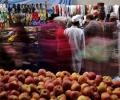
Recent estimates show that foodgrain production in 2016-17 has touched a new record of 273.4 million tonnes or 8.7 per cent higher as compared to last year.

In its mid-quarter review of monetary policy, RBI on Wednesday kept all key interest rates unchanged notwithstanding persistent high inflationary pressure.

RBI Governor Raghuram Rajan on Friday said keeping inflation low is the key task for sustainable economic growth of the country.
.jpg)
A section of the market believes RBI should hold rates as negative real rates will hurt savings and investment.

Vegetable prices which had witnessed a 21.16 per cent contraction in June, shot up by 21.95 per cent in July.

The party said its government has taken a number of initiatives since its formation including tough action against hoarders and limiting export prices of essential commodities like onion, rice and wheat.

Lower fuel subsidy payouts might restrict gross fiscal deficit in FY15.

The new IIP series based on the new base year, is expected to lead to better capturing of ground data
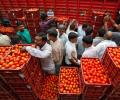
CPI inflation has declined by almost a percentage point from July, from close to eight per cent to just above seven per cent.
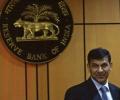
In a surprise move, the Reserve Bank on Wednesday left the repo rate unchanged at 7.75 per cent, while the cash reserve ratio too is retained at 4 per cent.

Global rating agency Moody's said India's economic growth remains weak and there is little chance of recovery next year.
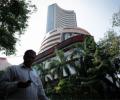
Profit-booking and selling pressure on below-normal monsoon forecast, marred sentiments, traders said.
Policymakers have been grappling with high prices for food staples such as onions and potatoes even after the central bank raised interest rates by a quarter percentage point in each of its previous two reviews.

The study was conducted along with its research partner -- Nielsen Company in the last quarter of 2013.

RBI may hold rates in Apr; to go for 25 bps cut by June: DBS
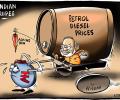
The Union government has collected Rs 94,181 crore through levy of excise duty on petrol and diesel in the first three months of the current fiscal on the back of a record tax on fuel that yielded 88 per cent higher revenue the previous financial year, the Lok Sabha was informed on Monday. Excise duty on petrol was hiked from Rs 19.98 per litre to Rs 32.9 last year to recoup gain arising from international oil prices plunging to multi-year low as pandemic gulped demand. The same on diesel was raised to Rs 31.8 from Rs 15.83 a litre, according to a written reply by Minister of State for Petroleum and Natural Gas Rameswar Teli in the Lok Sabha. This led to excise collections on petrol and diesel jumping to Rs 3.35 lakh crore in 2020-21 (April 2020 to March 2021), from Rs 1.78 lakh crore a year back, he said.

Disagreeing with Reserve Bank's projection on the price situation, former RBI Governor and PM's Economic Advisory Council chairman C Rangarajan said WPI and CPI may not be as high as being projected by the central bank.

The revised salaries of central government employees are likely to be paid from July 1, 2016.

Slight recovery in growth is expected only in July-September.

M&M was the biggest loser in the Sensex pack, declining nearly 3 per cent, followed by TCS, Bajaj Finance, Wipro, Kotak Bank, Tech Mahindra, HCL Tech and Tata Motors. In contrast, Titan, Bharti Airtel, ICICI Bank and L&T were among the gainers, rising up to 0.93 per cent.

The rupee depreciated 6 paise to 77.50 against the US dollar in the opening trade on Wednesday as a surging American currency in the overseas markets and persistent foreign fund outflows weighed on investor sentiment. Besides, rising global crude prices impacted the domestic unit, forex traders said. However, a higher opening in the domestic equity market restricted the rupee's fall, they added.
Brokers said a flurry of buying by investors in blue-chips mainly influenced the sentiment.
Jaitley said inflation has been under control for long and is likely to remain so on the back of good monsoon and unlikely spike in oil prices.

In fuel and power segment, inflation saw a sharp surge to a near double digit inflation at 9.99 per cent, against 4.37 per cent in July.
Inflation rose to 4.96 per cent for the week ended July 1 from 4.84 per cent
Higher prices of food products and some manufactured items pushed up inflation to 3.21 per cent for the week ended November 17, against 3.01 per cent a week ago.

Changes the base year and included more sectors.
Of the 52 economists polled, 50 expect the policy repo rate to remain at 7.25 per cent, and 47 of 48 respondents see the cash reserve ratio, or the portion of deposits banks have to maintain with the central bank, unchanged at 4 per cent.

India's consumer price index (CPI)-based inflation could ease in the coming months thanks to the arrival of kharif crops, lower international commodity prices, and a pass through of lower input costs to consumers, the finance ministry said in its Monthly Economic Review (MER) for October, which was released on Thursday. The MER, however, warned that the global macroeconomic situation remained precarious and a recession in many advanced economies would impact India's exports. "Easing international commodity prices and new Kharif arrival are set to dampen inflationary pressures in the coming months.
.jpg)
The rupee is set to breach the Rs 60-a-dollar mark again this week as the Street expects foreign institutional investors to continue pulling out of domestic markets. According to the street, this would result in government bond yields rising.

Reversing a six month declining trend, WPI inflation moved up marginally to 0.11 per cent in December mainly because of increase in prices of food items.

Equity benchmarks Sensex and Nifty halted their five-day rally on Tuesday and settled deep in the red, mirroring weak global markets, with decline in index heavyweights Reliance Industries, Infosys and HDFC Bank. Despite opening with gains of over 200 points, the 30-share Sensex turned highly volatile and tumbled 709.17 points or 1.26 per cent to close at 55,776.85. During the day, the benchmark index plunged 1,067.07 points or 1.88 per cent to 55,418.95. The broader NSE Nifty also declined 208.30 points or 1.23 per cent to close at 16,663.

The recovery in manufacturing is still likely to prove "protracted" given the lingering structural constraints.

According to the report, going forward, inflationary pressures in some items may increase due to slight improvement in demand.
.jpg)
Industry's demand for a reduction in the repo rate, currently 8 per cent, has gained momentum after wholesale and retail inflation eased in February.
.jpg)
Bank stocks have underperformed in the second quarter of FY'14 with the BSE Bankex declining 18 per cent compared to fall of 1 per cent in the BSE 30-stock index, Sensex, during this period.

Young investors could allocate in the proportion of 70:20:10 to equity, debt and gold.
 © 2026 Rediff.com - Advertise with us - Disclaimer - Privacy Policy - Sitemap - Feedback - About us - Terms of use - Grievances